


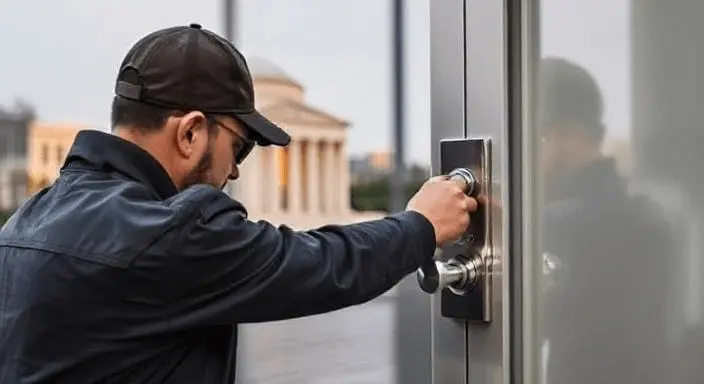
To choose a reliable locksmith in Washington, DC: confirm the company holds a DC Basic Business License, get a total price before dispatch, insist on a marked vehicle and a technician who accepts cards, and check that the business has a real local address. Mr. Locksmith DC is licensed, bonded, and insured — (202) 630-4979.
Most people hire a locksmith exactly once every few years, usually while standing outside in an unhappy mood. That combination — rare purchase, high urgency, no time to research — is why locksmith scams persist in Washington, DC while they have largely died out in other trades.
This guide is the ten minutes of research worth doing before you need one. It covers what DC law actually requires, the scam pattern to watch for, and the specific questions that separate a legitimate company from a call-center operation.

Is a locksmith required to be licensed in Washington, DC?
This is where most advice online gets DC wrong, so it is worth being precise.
The District does not issue a locksmith-specific occupational or trade license the way some states do. What DC does require is that any person or company providing services for compensation in the District holds a Basic Business License (BBL), issued by the Department of Licensing and Consumer Protection (DLCP) — the agency that took over this function from the former DCRA.
So the meaningful question is not “are you a licensed locksmith?” — a scammer will say yes to that. The meaningful question is “what is your legal business name and BBL?” A real company answers without hesitation. An operation running out of a rented car and a national call center cannot.
Two more credentials worth asking about, neither of which is legally mandated but both of which indicate a serious business:
- Insured — if a technician damages your door, frame, or vehicle, insurance is what pays for it. Without it, you do.
- Bonded — a surety bond provides recourse if work is not completed as agreed. It also means a third party vetted the business.
How does the DC locksmith scam actually work?
The pattern is consistent enough to recognize in advance:
- You search for a locksmith and find an ad quoting something implausible — $15, $19, $29 “starting at.”
- You call. A dispatcher with no local knowledge takes your address and confirms the low price.
- An unmarked personal vehicle arrives. The technician has no uniform, no company ID, and often limited English or a story about being a subcontractor.
- They inspect the lock and announce it is “high security” and must be drilled.
- The final bill is three to five times the quote, in cash, and you now also need a replacement lock they conveniently sell.
The advertised price was never real. It exists to win the click. The drilling is not a technical necessity — it is the mechanism that justifies the upcharge and the parts sale, because a technician who cannot pick a lock has only one way in.
The tell that catches this earliest: a legitimate locksmith gives you a price range on the phone and explains what would move it. “It depends, we’ll tell you when we get there” is how the scam begins.
What should I ask before a locksmith is dispatched?
Six questions, about ninety seconds:
- “What is your legal business name and address?” Then search it. A DC address you can find on a map is a good sign; a company that only exists as a phone number is not.
- “What is the total, including the service call?” You want a range and the factors behind it, not a floor price.
- “Is there an after-hours or weekend surcharge?” Many companies charge more outside normal hours; we do not — our hours are 6:30 a.m.–11:30 p.m., seven days a week, at the same rates.
- “Will the technician arrive in a marked vehicle, and can they show company ID?”
- “Do you accept credit cards?” Cash-only is the strongest single warning sign, partly because a card payment is disputable and cash is not.
- “Will you need to drill the lock?” The right answer is that drilling is a last resort for high-security cylinders, not a default.
What does a real locksmith actually do?
Worth knowing, because it shapes what you should expect for the money. The trade is considerably broader than opening doors:
- Emergency entry — non-destructive opening of homes, offices, and vehicles
- Rekeying — changing a lock’s internal pins so old keys stop working, without replacing hardware
- Lock installation and repair — deadbolts, mortise locks, smart locks, storefront hardware
- Automotive — cutting and programming transponder keys, fobs, and push-to-start smart keys
- Commercial systems — master key systems, panic hardware, access control, door closers
- Safes — installation, servicing, and opening
Experience matters most on the jobs that go wrong. In DC that means historic doors. A Georgetown or Capitol Hill rowhouse may have an original mortise lock in a frame that has moved half an inch over a century. A technician who only knows modern cylindrical hardware will damage that door. One who has worked DC’s older housing stock will not.

How do I check reviews properly?
Read the Google Business Profile, not just the star rating. Look for reviews that describe a specific job, a named neighborhood, and a real timeline — those are hard to fake at volume. A profile with hundreds of reviews that all read like slogans and appeared in the same month is worth distrusting.
Cross-check on a second source. Yelp and the Better Business Bureau both surface complaint history that a company’s own site never will. And check whether the business responds to negative reviews; how a company handles a bad job tells you more than a wall of five stars.
Frequently asked questions
Do locksmiths in Washington, DC need a license?
DC does not issue a locksmith-specific trade license, but every business operating in the District must hold a Basic Business License from the Department of Licensing and Consumer Protection. Ask for the legal business name and BBL — that is the credential that actually exists in DC.
What is a fair price for a lockout in DC?
At Mr. Locksmith DC a house or apartment lockout runs $145+ and a car lockout $125+. We are open every day from 6:30 a.m. to 11:30 p.m. Rekeying is $45+ per lock. Anything advertised at $19 or $29 is a bait price, not a real one.
Should I let a locksmith drill my lock?
Only after they have tried to open it non-destructively and explained why they cannot. Most residential deadbolts can be picked or bypassed intact. Immediate drilling on a standard lock usually means the technician lacks the skill, and you will pay for a replacement you did not need.
What ID will a locksmith ask me for?
Proof that you are entitled to enter — a license showing the address, a lease, recent mail, or vehicle registration. Any locksmith who does not ask is one who would open your neighbor’s door just as readily.
Is the cheapest locksmith ever the right choice?
Rarely. The genuine price differences between reputable DC locksmiths are modest. A quote far below everyone else is not a better deal — it is the opening move of the bait-and-switch described above.
Working with Mr. Locksmith DC
We are a family-owned, licensed, bonded, and insured locksmith serving all of Washington, DC, with marked vehicles, up-front pricing, and an average response time of 20–30 minutes. We handle residential, commercial, automotive, and emergency work across every DC quadrant.
Call (202) 630-4979, or if you are locked out right now, read what to do when you are locked out.
