



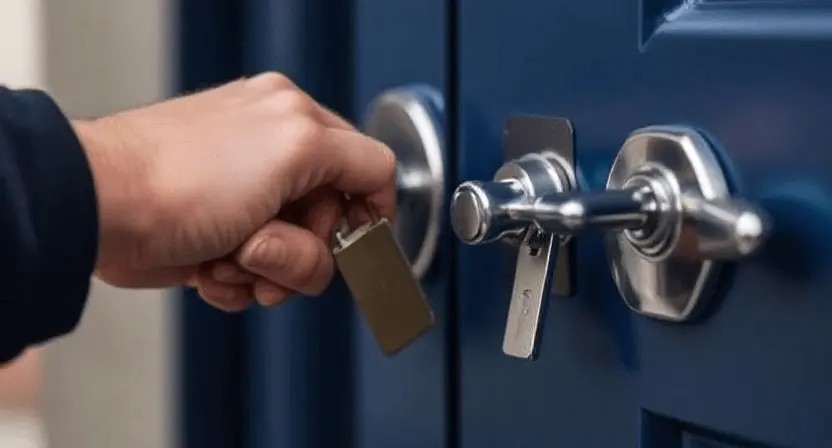
Locked out in Washington, DC? Call a licensed locksmith rather than forcing the door — a house lockout runs $145+ and a car lockout $125+, while a damaged door or frame costs far more to repair. Mr. Locksmith DC reaches most DC addresses in 20–30 minutes, seven days a week, at (202) 630-4979.
Getting locked out of your home, car, or office is one of those problems that feels like an emergency the moment it happens. You are standing on the wrong side of your own door, possibly in the rain on a Shaw rowhouse stoop or in a Navy Yard parking garage, and every minute feels longer than it is.
The good news: almost every lockout in DC is solved without damage, usually in well under an hour. This guide walks through exactly what to do, what it should cost, and how to avoid the mistakes that turn a $145 problem into a four-figure one.

What should I do first when I get locked out?
Before you call anyone, take sixty seconds and check the obvious. In DC’s older housing stock — Capitol Hill rowhouses, Adams Morgan Victorians, Columbia Heights walk-ups — the back door, basement entry, or a ground-floor window is unlocked more often than people expect.
- Check every door, not just the one you came to. Rear and basement doors are the usual find.
- Ask who else has a key. A roommate, partner, neighbor, or nearby family member is faster and cheaper than any locksmith.
- If you rent, call building management first. Many DC apartment buildings and condo associations keep unit keys on site and will let you in for free or a small fee. Larger buildings in NoMa, The Wharf, and Navy Yard almost always have a concierge or on-call maintenance line.
- If you are locked out of a car with a child or pet inside, stop reading and call 911. That is a genuine emergency and DC Fire and EMS will respond immediately.
Should I try to open the door myself?
Sometimes — but the honest answer is that the DIY methods circulating online work on a narrow set of locks and cause expensive damage on everything else.
The credit card trick only works on a spring-latch lock with no deadbolt engaged, and it scratches or bends the card and often the strike plate. It does nothing against a deadbolt, which is what secures most DC exterior doors. Picking a lock with a bobby pin is realistic on cheap interior privacy knobs and essentially never on a modern Schlage or Kwikset deadbolt.
The methods you should genuinely avoid: prying with a screwdriver, kicking the door, or drilling the cylinder. Prying deforms the frame, kicking splits the jamb, and drilling destroys a lock that could have been opened intact. On a historic Georgetown or Capitol Hill door — where the frame may be original and the hardware is a mortise lock no big-box store stocks — the repair bill can run into four figures. A locksmith’s non-destructive entry is cheaper than any of those outcomes.
Car lockouts deserve their own warning. The coat-hanger trick belongs to an era of manual pull-post locks. On any vehicle built in the last twenty-odd years you are far more likely to tear the weather seal, scratch the paint, or damage the window regulator and side-curtain airbag wiring than to open the door.
How much does an emergency locksmith cost in Washington, DC?
Pricing varies with the lock, the door, and the time of day. These are Mr. Locksmith DC’s starting prices:
- House or apartment lockout: $145+
- Car lockout: $125+
- Rekeying a lock (worth doing on the spot if your keys are lost rather than inside): $45+ per lock
- Evenings and weekends: same rates — we are open every day, 6:30 a.m. to 11:30 p.m.
A high-security or restricted-keyway lock, a mortise lock in a historic door, or a commercial storefront with an interlocking deadbolt costs more than the starting price because the work takes longer and demands more specialized tools. You get the price before we start — not after the door is open.
How do I avoid a locksmith scam?
DC is an active market for locksmith bait-and-switch operations, and a lockout is exactly when people are most vulnerable to one. The pattern is consistent: an ad quotes $15–$35, an unmarked car arrives, the technician announces the lock must be drilled, and the final bill is three to five times the quote — cash only.
Four questions filter out nearly all of them:
- “What is the total price, including the service call?” A real locksmith gives you a range over the phone and explains what moves it.
- “What is your business name and license?” DC does not issue a locksmith-specific trade license, but every business operating in the District must hold a Basic Business License from the Department of Licensing and Consumer Protection. A company that cannot name its own legal business identity is a red flag.
- “Is your vehicle marked?” Established local companies run branded trucks.
- “Do you take cards?” Cash-only insistence is the single most reliable warning sign.
Also be skeptical of drilling. A skilled locksmith opens the overwhelming majority of residential locks without destroying them. Immediate insistence on drilling a standard deadbolt usually means the technician cannot pick it — and you will be charged for a replacement lock you did not need.

What happens when the locksmith arrives?
Expect to prove the place is yours — this protects you as much as it protects us. A driver’s license with the address, a lease, a piece of mail, a vehicle registration, or a building manager who can vouch for you all work. If your ID still lists an old address, mail or a lease with your name is usually enough.
From there the technician picks or bypasses the lock, opens the door, and checks that the hardware still works properly afterward. If your keys were lost rather than left inside, this is the moment to consider rekeying the lock — whoever has those keys still has access to your home, and rekeying while the locksmith is already on site costs a fraction of a separate visit.
How do I keep it from happening again?
Leave a spare with someone you trust nearby. Keep a copy at your office. A key lockbox mounted discreetly works well for rowhouses and is standard in much of DC. And if you are tired of the whole category of problem, a keypad or smart deadbolt eliminates it — worth considering if you rent out a unit, host guests, or simply lose keys more than once a year.
One DC-specific note: doors swell in the summer humidity and stiffen in winter cold. A lock that has been getting harder to turn for weeks is telling you something. That is a small service call now instead of a lockout later.
Frequently asked questions
How long does a locksmith take to arrive in DC?
Mr. Locksmith DC averages 20–30 minutes across the District. Traffic, time of day, and your location relative to downtown all affect it — a Georgetown call at rush hour takes longer than a Dupont Circle call at 7 a.m.
Can a locksmith open my door without damaging it?
In the large majority of residential lockouts, yes. Standard deadbolts and knob locks are opened non-destructively with picking or bypass tools. High-security cylinders such as Medeco or Mul-T-Lock are designed to resist exactly that, so those occasionally require drilling and replacement.
Do I need to be there when the locksmith arrives?
Yes. Someone who can prove they are authorized to enter must be present. This is standard practice for every legitimate locksmith and it is what stops the service from being used to break into other people’s homes.
Is a locksmith cheaper than calling my landlord?
Usually not — if your building has on-site management, that is almost always the cheapest option. Call them first. A locksmith is the answer when management is unreachable, charges a steep after-hours fee, or you own the property.
Can a locksmith make a new key if mine is lost, not locked inside?
Yes. A locksmith can cut a new key from the lock itself, and for cars can originate and program a new transponder key or fob on site. See our automotive locksmith services for vehicle key replacement.
Locked out right now?
Mr. Locksmith DC provides emergency lockout service across Washington, DC every day from 6:30 a.m. to 11:30 p.m. — NW, NE, SW, and SE — including Capitol Hill, Dupont Circle, Georgetown, and every neighborhood in between. Licensed, bonded, insured, and driving marked trucks.
Call (202) 630-4979 — or read more about our emergency locksmith services.