



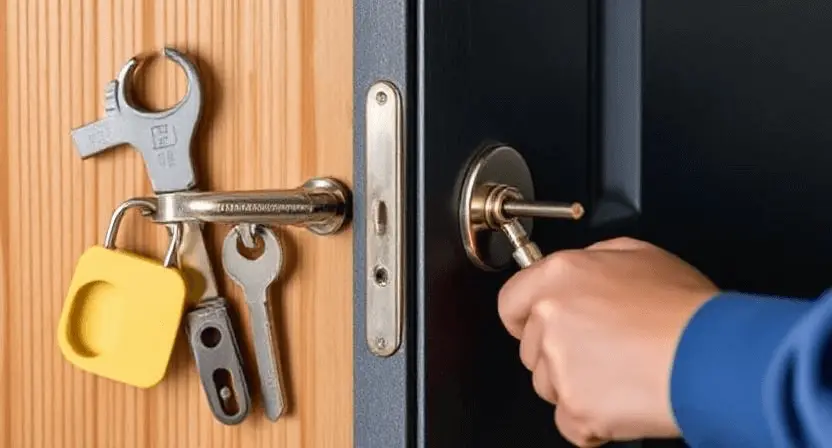
DIY works for swapping a like-for-like deadbolt, tightening loose hardware, and lubricating a stiff lock. Call a professional for lockouts, rekeying, car keys, mortise locks in historic DC doors, and any door that no longer closes squarely. Mr. Locksmith DC: (202) 630-4979.
Plenty of lock work is genuinely DIY. The trouble is that the jobs which look easiest from a YouTube thumbnail are often the ones that damage a door, and in Washington’s older housing stock the door is worth considerably more than the lock.
Here is an honest split.
What can I safely do myself?
- Replacing a deadbolt with the identical model. If the new lock matches the old one’s backset and bore, this is a screwdriver job. Take a photo before you disassemble anything.
- Tightening loose hardware. A wobbly knob or lever is usually two screws. Left alone it wears the internals and eventually fails.
- Lubricating a stiff cylinder. Use a dry graphite or PTFE lubricant. Never WD-40 — it is a solvent, it strips the existing lubricant, and it leaves a residue that attracts grit.
- Installing a basic keypad lock on a modern door. Most consumer smart locks are designed for a standard bore and come with clear instructions.
- Adjusting a strike plate slightly. If the latch just barely misses, filing the strike or moving it a few millimetres often fixes it.

When should I call a professional?
You are locked out
This is the clearest case, because the DIY failure modes are expensive. Prying with a screwdriver bends the frame, kicking splits the jamb, and drilling destroys a lock that could have been opened intact. A lockout costs $145+ at our rates; a replacement door and frame on a historic rowhouse costs many times that.
Your keys were lost or stolen
Rekeying requires disassembling the cylinder and repinning it to a new key. Consumer rekey kits exist for some Kwikset lines, but they only work on that specific hardware and give you no help with anything else in the house. At $45+ per lock, and with the ability to key several doors alike, this is not a job worth fighting.
The door itself has moved
This is the most common misdiagnosis we see in DC. A latch that no longer catches, a deadbolt you have to lift the door to throw, a lock that binds in August but not in January — those are door and frame problems, not lock problems. DC’s humidity swings and century-old framing mean rowhouse doors move seasonally. Replacing the lock will not fix it, and forcing the bolt will damage both.
It is a mortise lock or a historic door
Older Georgetown, Capitol Hill, and Adams Morgan homes often have mortise locks — a rectangular lock body set into a pocket in the door edge, with a mechanism nothing like a modern cylindrical lock. There is no drop-in replacement at a hardware store. These are repaired or retrofitted, and doing it wrong means routing out an irreplaceable original door.
Car keys of any kind
Cutting is only half the job; the chip or fob has to be programmed to your vehicle. This requires diagnostic equipment, not a hardware store. See our automotive locksmith services.
Anything commercial
Storefronts and offices carry code obligations that homes do not — panic hardware and fire-rated door assemblies in particular. Modifying them incorrectly is both a safety problem and a liability one. Our commercial locksmith work covers that ground.
What does DIY actually cost when it goes wrong?
The common outcomes, roughly in order of how often we see them:
- A misaligned install. The lock works but the bolt does not seat fully, so the door is less secure than before and the lock wears fast.
- A broken key in the cylinder from forcing a stiff lock instead of servicing it. Extraction is straightforward for a locksmith and nearly impossible without the right tool.
- A stripped or over-drilled bore from fitting a lock that did not match the door prep — usually terminal for the door.
- A damaged frame from a forced entry attempt, which is carpentry, not locksmithing.
The pattern is consistent: the DIY attempt does not just fail, it converts a small job into a larger one. If a task requires force, stop. Locks that are working correctly do not need force.
Frequently asked questions
Can I rekey my own locks?
On certain consumer lines with a manufacturer rekey kit, yes. For anything else, or for keying several doors to one key, a locksmith is faster and the pinning is done correctly. We charge $45+ per lock.
Why is my door lock suddenly hard to turn?
Usually the door has shifted rather than the lock failing — very common in DC rowhouses with seasonal humidity. Try dry lubricant first. If the bolt still binds, the strike alignment needs adjusting, which is worth a service call before the lock breaks.
Is WD-40 safe to use on locks?
No. It is a solvent and water displacer, not a lubricant. It strips the factory lubricant and leaves residue that collects dust, so the lock feels better for a few weeks and then worse than before. Use graphite or a PTFE-based lock lubricant.
Can I install a smart lock myself?
Often yes, on a modern door with a standard bore. It gets harder with non-standard backsets, metal doors, or historic mortise hardware — in those cases a retrofit is the right approach.
How do I know whether it is the lock or the door?
Open the door fully and operate the lock with the door swung clear of the frame. If the bolt moves smoothly, the lock is fine and the problem is alignment. If it binds in open air, the lock itself needs service.
Not sure which side of the line you are on?
Call (202) 630-4979 and describe the problem — we will tell you honestly if it is something you can handle yourself. We serve every DC neighborhood, including Georgetown, Capitol Hill, and Adams Morgan, where historic doors make the DIY calculation trickier than usual.